
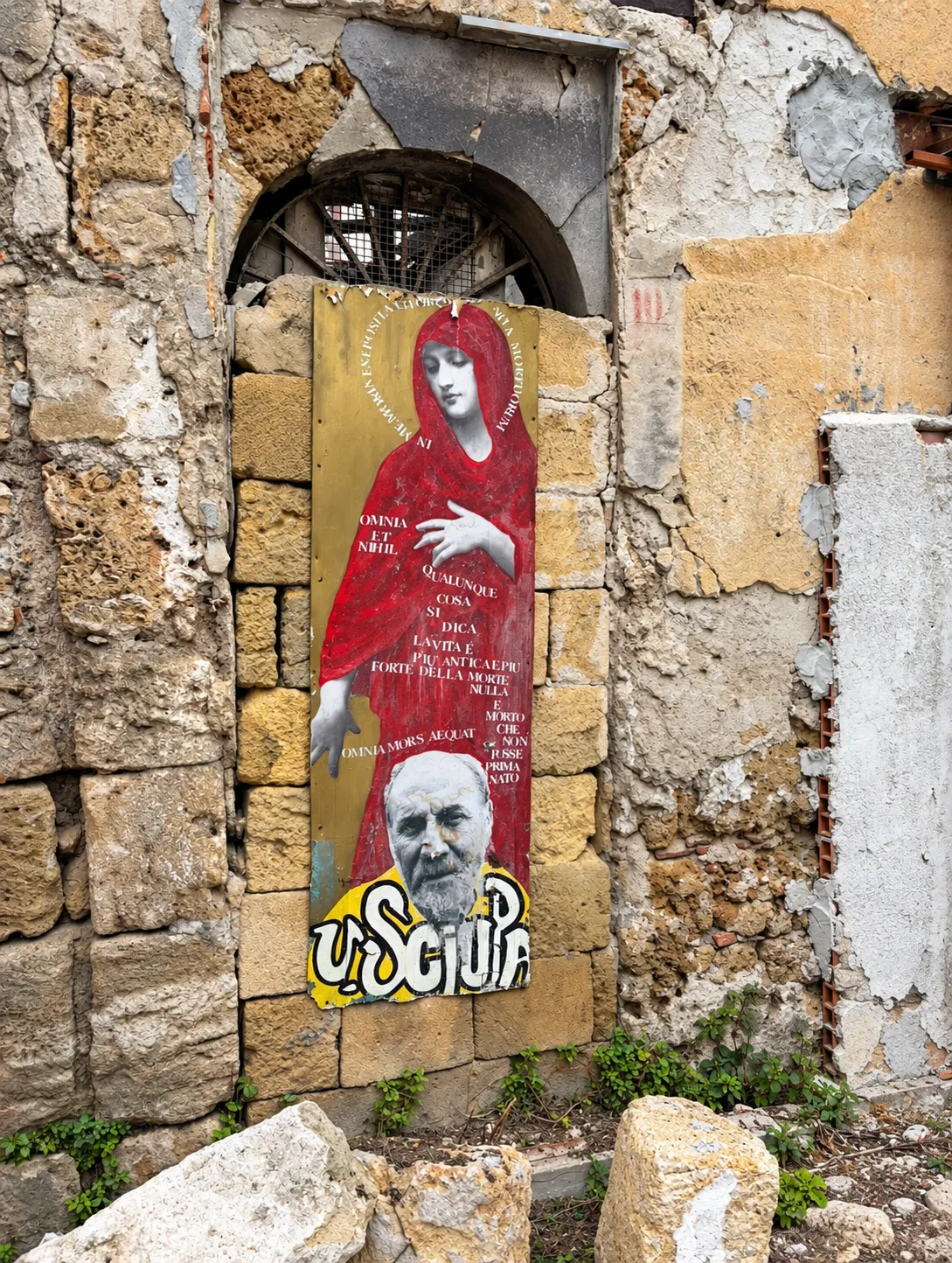
U Sciupa
I really love the courtyards of Capo. To me, they’re pure chaos, but the kind of chaos where you can always find something interesting. If you’re into street art, it’s worth taking a look at Via Carrettieri — the street that was once home to workshops making carts, Sicilian carretti, and to the men who drove them. Around there, you can find a few small, half-abandoned blocks covered in street art, including works by the well-known Palermo artist Tutto e Niente.
One of those works is dedicated to a local man, Nino U Sciupa. U Sciupa is a Sicilian nickname, shortened from sciupafemmine — politely speaking, a man who really loved women. Or, more simply, a womaniser. He was handsome and successful. He loved women and beautiful cars. He liked a drink and wasn’t exactly the type to stay out of a fight. He even spent time in prison, although people say he was there because of someone else.
Then U Sciupa met the woman he would spend the rest of his life with. Together they adopted two children, born to two different women who worked as prostitutes in the Capo neighbourhood. To convince the authorities to let them take the children into their family, people from Capo collected signatures in support of them, despite Nino’s rather complicated reputation.
Then something changed in his successful life, and the family became very poor. Nino started collecting things people had thrown away in the streets and selling them at the Ballarò flea market. And the little money he made from that, he spent on food and clothes for African women and children living around Ballarò. That’s how he got his second nickname: l’Africano Bianco — the White African.
In 2018, when he was 74, a fire broke out in his home. He and his wife managed to get out, but Nino went back inside. Some say he went back to try to put out the fire; others say he thought his nephew was still inside. There’s no single clear version of what happened. He died in the fire. Today, in memory of this legendary resident of Capo, you can find his portrait with the Madonna behind him, painted by Tutto e Niente on the wall opposite his burned-out home.