
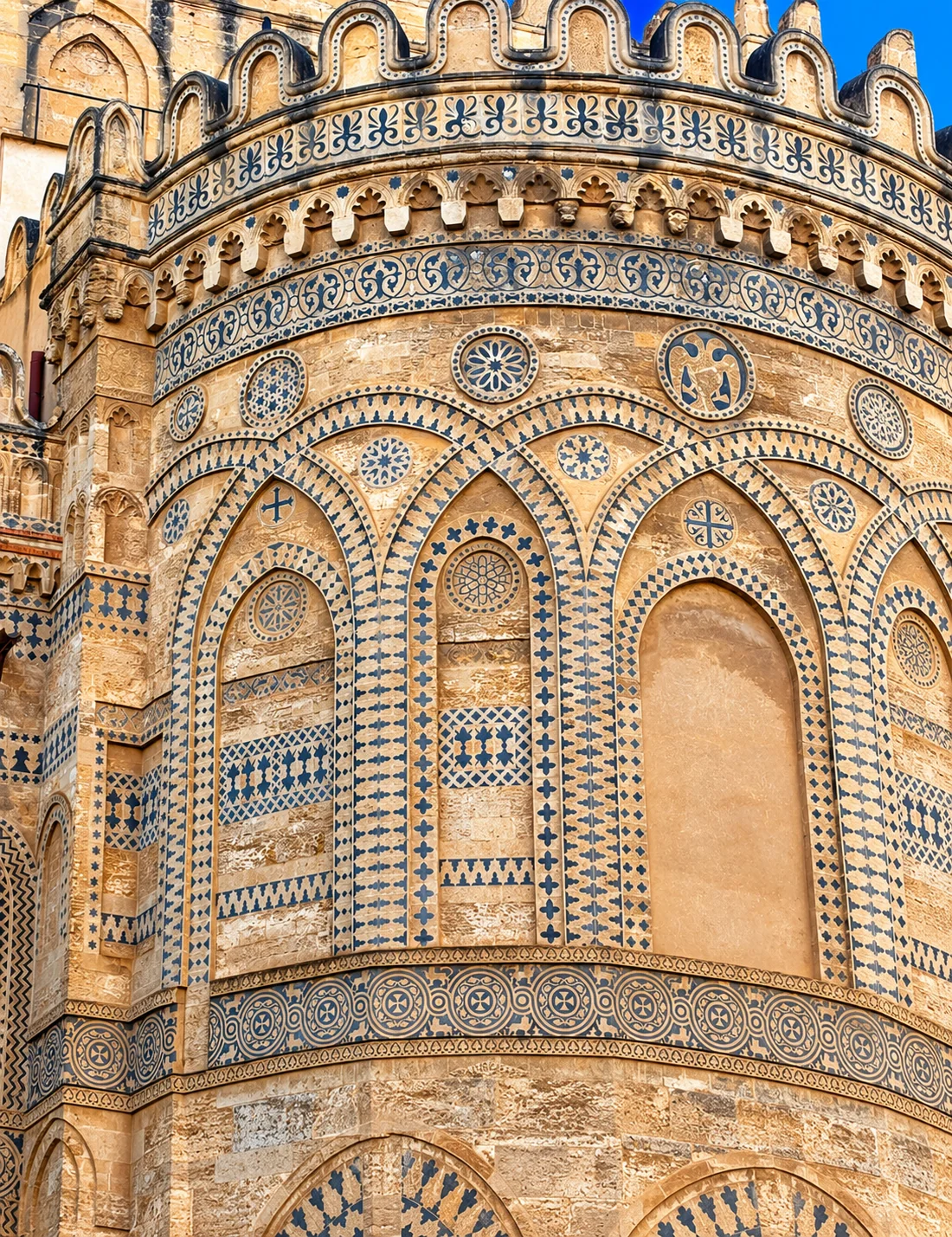
Arab-Norman Style
Another unique cultural feature of Palermo is its Arab-Norman architecture. The reason for its uniqueness lies in history. To put it very roughly and briefly, Palermo was inhabited by Byzantine Greeks, then the Arabs arrived, and later came the Norman conquest. These were the same descendants of the Vikings who had settled in France and transformed from pagans into obedient Catholics.
So they began to “correct” the Arab city of Palermo. Some things were demolished, while others were rebuilt. On the site of the Cattedrale di Palermo, there had once been an early Christian basilica, which the Arabs turned into the main mosque, and the Normans later built a Catholic cathedral there. Alongside Byzantine mosaic masters and Western architects, builders were also recruited from the city’s population, which was predominantly Arab. They skilfully preserved and emphasised Arab elements in the new Catholic architecture. This is how the traditions merged and the Arab-Norman style emerged.
In general, simplifying again, when the Normans arrived, Palermo was a wealthy and ethnically complex capital of Sicily. They preserved and skilfully used the experience of Greek officials, Arab craftsmen, Muslim administrators and Jewish merchants. It was a city of three languages: Latin, Greek and Arabic. Even the royal chancery issued official documents in one of these three languages, depending on their purpose, or in all three languages at once.
So whenever you see Arab ornamentation on buildings in Palermo, this is exactly what it is: the Arab-Norman style. This definitely applies to all the UNESCO heritage buildings in Palermo, Monreale and Cefalù. By the way, the striking church with three round red domes in Piazza Bellini, which is also part of the UNESCO heritage, is not an Arab church but a Catholic one built in the Arab-Norman style.