
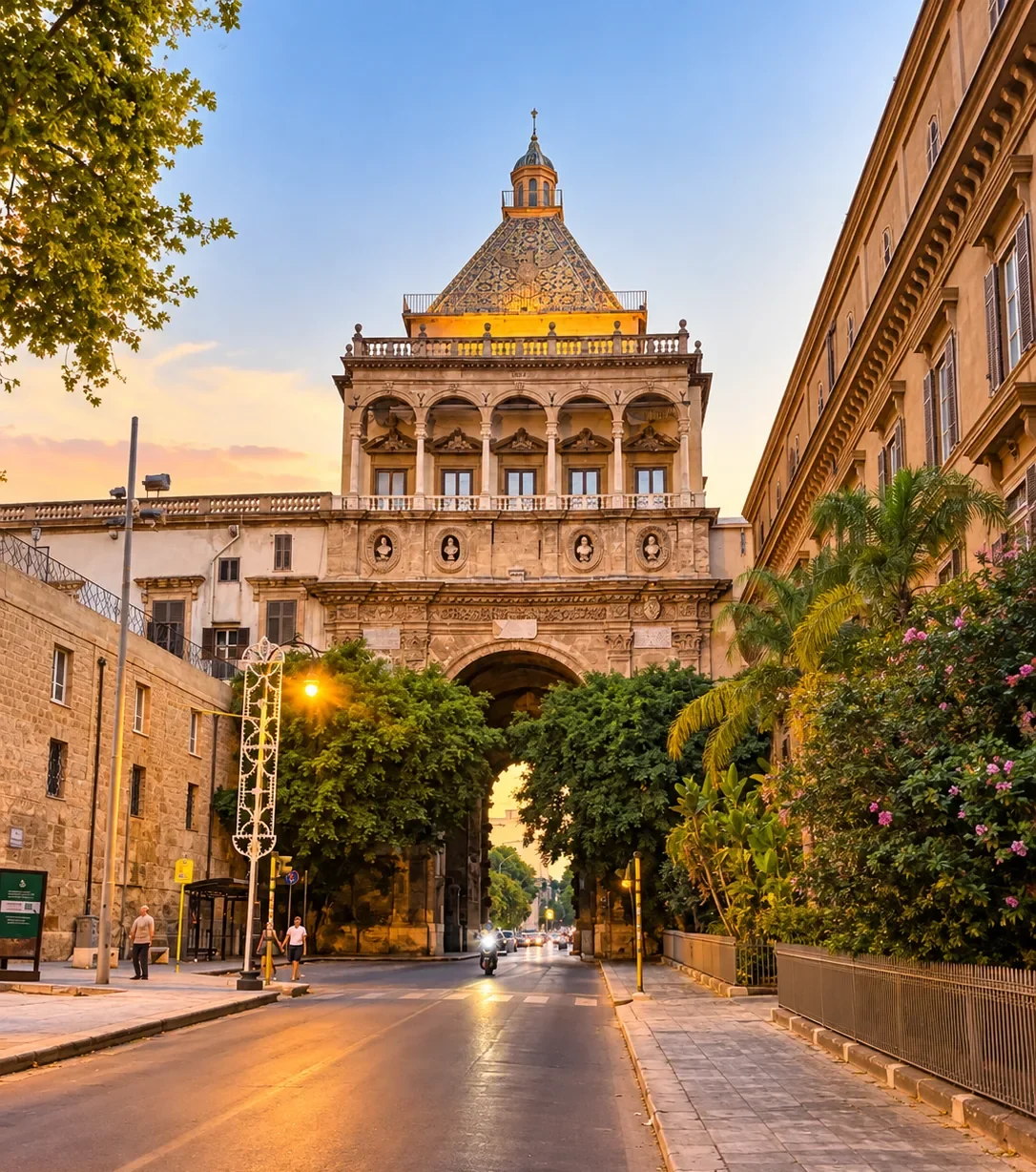
Porta Nuova
I really love stopping somewhere in the middle of Via Vittorio Emanuele (Cassaro) and looking toward its two ends. On the side of Palazzo Reale, I see Porta Nuova decorated with majolica. And on the sea side — Porta Felice. I don’t know why, but I really love city gates and in every city I pay attention to them. I will begin my journey through the gates with Porta Nuova.
They can be called the ceremonial gates of the city because they are located next to the Royal Palace. These gates are more than 300 years old, but the first documented city gates, Porta del Sole, stood here even before the 15th century.
Then Porta dell’Aquila stood on this site for 120 years — the Eagle Gate, named after the bird that is the symbol of Palermo. After the victory over the Moors in Tunis, it was decided to renew the gates in honor of the triumph, and Porta Nuova was built. Although the name was different, people called them the new gates — and that is the name that stuck. The new gates stood for just under 100 years and were completely destroyed by an explosion at the gunpowder warehouse located next to them. And then the new Porta Nuova were built, the ones we can see today.
When entering the city from the direction of Monreale, you can see four giants who do not look alike. Two of them have their hands tied, like prisoners of war, while two have their hands cut off — as if they are unable to continue the war. And if you enter the city and look at the gates from the other side, you can see four female busts symbolizing Peace, Justice, Truth, and Abundance.
At the top of the gates is an eagle, the symbol of Palermo and a reminder of the old Porta dell’Aquila. They say that after the plague epidemic ended, an image of the Immaculate Virgin Mary and an inscription of gratitude for the salvation of the city were added to those old gates. I really love walking through these gates and feeling that 600 years ago, or perhaps even a thousand, another person entered the city right here. And it is as if we are walking beside each other.