
Villino Florio
The first time I went to Villino Florio, I took a very complicated route through poor, non-touristy areas of Palermo. Looking around, I started searching for an answer to the question: “Why did one of the richest families in Italy at the end of the 19th century build their house here?! What was Palermo like in those years?”
On the way back, it turned out that I was not actually that far from the Teatro Massimo — I had simply chosen a strange route. And still, today this part of the city lies outside the main tourist areas. It turned out that as early as the 18th century, this district was a wealthy suburb where Palermo’s nobility liked to enjoy the fresh air.
At the dawn of the Liberty era, the Florio family bought three hectares of land in this area to build a park and a country house. Villino Florio itself can be considered an example of Italian Art Nouveau — or simply a place where you can understand what the Liberty style is.
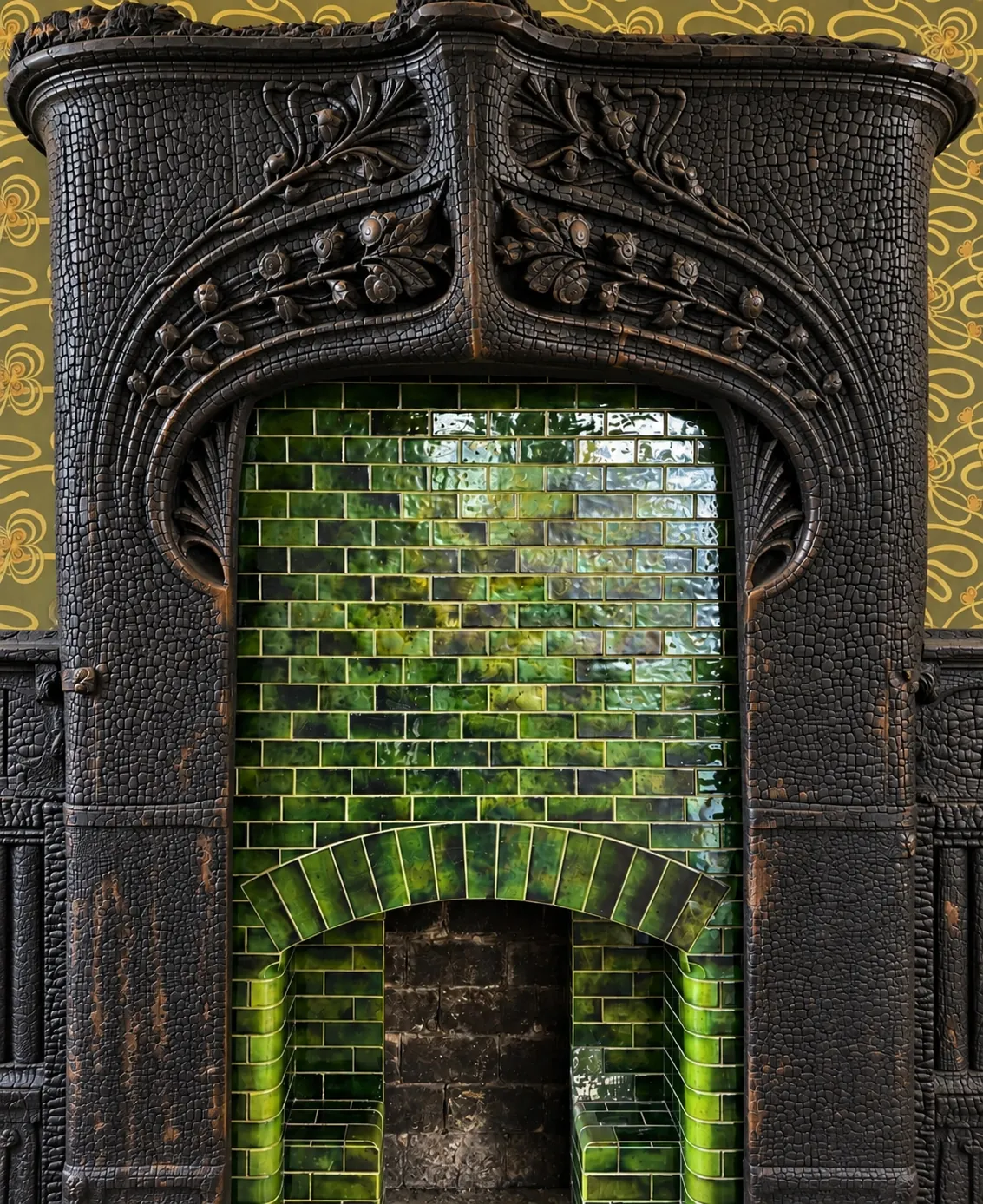
I started reading the history of the house after I had been inside, and I still remember my first impression. I was standing near a beautiful fireplace with malachite-coloured tiles, framed by some strange black wood. I began looking around and noticed that everything around me was partly framed with black wood. It turned out to be burnt wood.
The story was fascinating. Villino Florio was designed as a complete composition — meaning that the architect’s project included the building itself, the interior decoration and even the furniture. One of its most beautiful features is the carved wooden decoration. The Florio family sold both the park and the house in the early 20th century, when their financial empire began to collapse. By the 1960s, it had become a semi-abandoned building. At the same time, the city was going through a period known as the “Sacco di Palermo” — a wave of mass construction during which historic villas and palazzi “disappeared” and apartment blocks were built in their place.
This also happened to Villino Florio — the villa burned down. Later, thanks to activists who fought to preserve the Florio heritage, it was restored using the surviving drawings by the architect and Florio himself. During the restoration, everything was recreated from scratch. For example, if you look closely at the fabric on the walls, it was rewoven according to old samples, rather than replaced with something merely “similar to what had been there.” Part of the villa was left burnt, and in my opinion, it is a perfect combination of memory, aesthetics and the preserved work of the original architect.